Predoctoral Researcher · Department of Economics
National University of Singapore
I am a political science researcher working at the intersection of quantitative
methodology, causal inference, AI safety, and comparative governance. At NUS I work on
randomised controlled trials, regression discontinuity design methodology, and
comparative projects on intragenerational democracy and social mobility. My broader
research addresses misinformation, political behaviour, and institutional
decision-making across democracies, with growing interest in LLM-based causal
inference tools for the social sciences.
I am a Core Fellow at the Oxford AI Safety Initiative (OAISI) and an
AI Safety/Governance Research Fellow at Impact First (Arcadia Impact).
Multi-Dimensional Bias in Modelling Multi-Dimensional Preferences
With Ho Ting (Bosco) Hung and Yiwen Zhang · 2025
This paper examines sources of multi-dimensional bias that arise when modelling
multi-dimensional political preferences, with implications for the measurement of voter
ideology and party positioning in comparative political research.
Works in Progress
Evaluating Political Counterfactuals at Scale: A Framework Using LLM-Based Synthetic Agents
Independent · Ongoing
Political and policy questions — concerning democratic reform, institutional breakdown,
and crisis management — frequently hinge on counterfactual reasoning in settings where
experimentation is infeasible. Existing methods face a persistent trade-off: qualitative
approaches offer rich causal narratives but cannot scale, while quantitative methods
generalise well but struggle with rare or path-dependent outcomes. This paper develops
a methodological framework that treats LLM-based synthetic agents as controlled
experimental environments for approximating counterfactual political realities,
and proposes criteria for assessing the credibility and limits of
simulation-generated counterfactuals.
Synthetic Respondents in Political Research: Validity and Limits of LLM-Based Survey Simulations
Independent · Ongoing
Recent applications of LLM-based synthetic agents in experimental survey research raise
fundamental questions about when such simulations are informative and when they are
misleading. This paper examines the conditions under which synthetic respondents
approximate real political preferences and behaviour, developing a systematic
framework for evaluating the external validity of LLM-based survey simulations
and their appropriate scope in political science research.
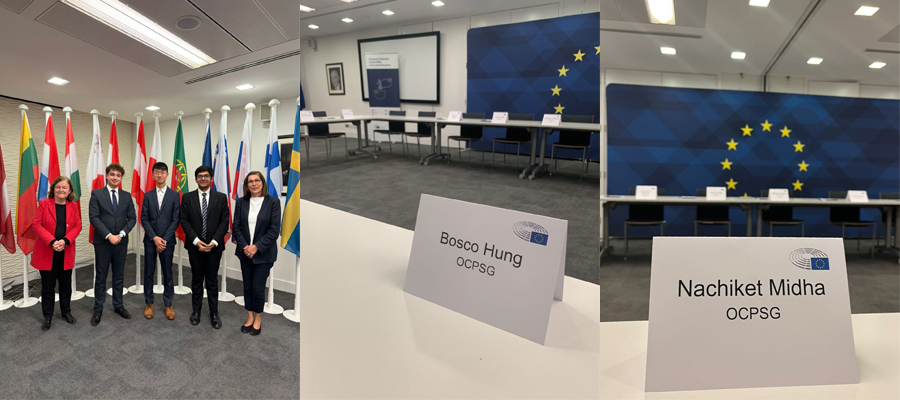
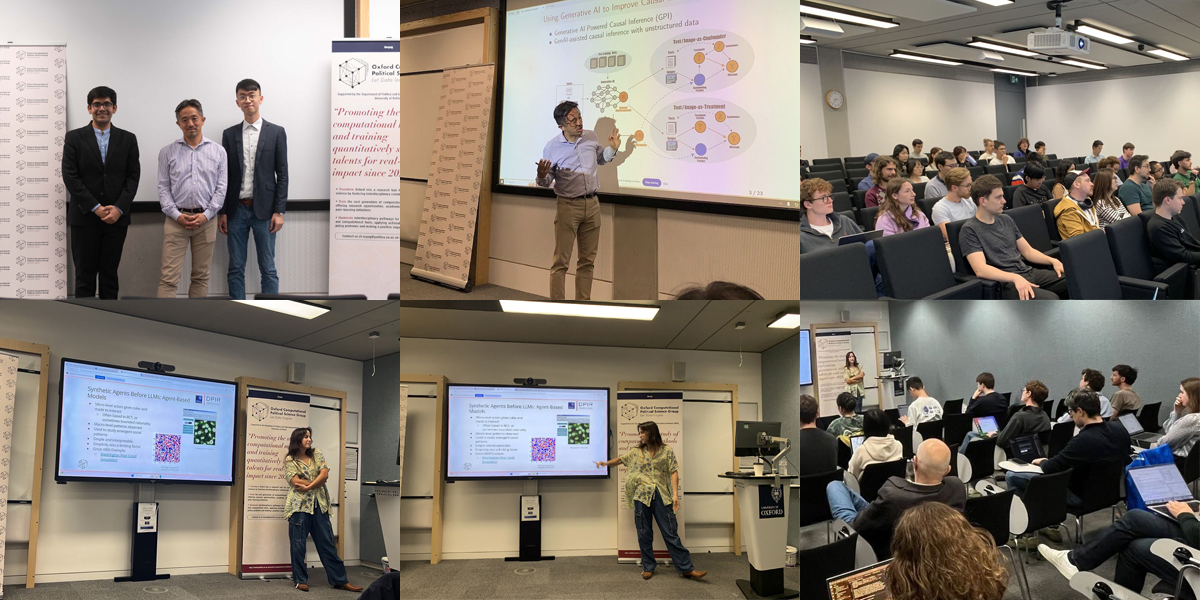
Oxford Computational Political Science Group
I co-founded the
Oxford Computational Political Science Group (OCPSG)
,
an Oxford-affiliated interdisciplinary research network supported by the Department of
Politics and International Relations (DPIR). OCPSG is a non-partisan initiative dedicated
to advancing computational methods in political science, fostering an environment that
blends political science with computational techniques to address complex political questions.

 University of Oxford
 Nat'l Univ. of Singapore
 Ashoka University
 Centre for Policy Research
 ISAS, NUS
 Sciences Po
 OCPSG, Oxford