AI Safety Research & Fieldbuilding, Trajan House, Oxford
Incoming Predoctoral Researcher · Department of Economics
National University of Singapore
I am an AI Safety researcher working specifically on risks from persuasive AI. I am currently based at
Trjan House, Oxford. I am directly working with EA Oxford in helping them design their Research Impact
Oxford (RIO) fellowship, and I will be the Research Manager for the 2026-27 iteration of this fellowship, managing
mostly the Technical AI Safety and Governance projects. Read more about RIO here.
Before this, I co-founded
the Oxford Computational Political Science Group (now institutionalised at the University of Oxford).
At NUS, I will be working on AI & Economics, RCTs, RDD methodology, comparative projects on
intragenerational democracy and social mobility, and a project on historical institutions.
My broader research addresses misinformation, political behaviour, and institutional
decision-making across democracies, with growing interest in LLM-based causal
inference tools for the social sciences.
I was an AI Safety Research Fellow at Arcadia Impact (Impact First Fellowship),
where I led a research team in the AI Safety stream, and an
AI Safety Core Fellow at the Oxford AI Safety Initiative (OAISI).
Multi-dimensional Bias in Modelling Multi-dimensional Preferences: Evaluating the Ability of Synthetic Agents to Replace Human Participants in Conjoint Experiments
With Ho Ting (Bosco) Hung, Victor Y. Wu, and Yiwen Zhang · 2026
Despite growing interest in using LLMs to add robustness or reduce data-collection
costs in social science experiments, their efficacy in conjoint design — an increasingly
popular method in political science — remains underexplored. This paper addresses that
gap by investigating whether synthetic agents can reproduce the multi-dimensional
preference patterns that conjoint is designed to capture. It replicates published
conjoint studies and systematically compares the results generated by synthetic agents
with original human data along three dimensions: representational correspondence,
inferential correspondence, and procedural stability. Our analysis evaluates the
alignment of choice distributions as well as the statistical and substantive similarity
of estimates. We find that synthetic agents often approximate marginal attribute-level
distributions and sometimes recover the direction of AMCE/MM estimates, but they
perform poorly on full joint profile distributions, individual-level choice alignment,
precise effect magnitudes, subgroup heterogeneity, and stability across models. These
findings suggest that the validity of synthetic participants should be considered
claim-dependent and hierarchical: reproducing a published figure or obtaining strong
sign agreement is evidence of aggregate output similarity, but not sufficient evidence
of respondent replacement.
Active Projects
Regulating Persuasive AI: Why Compute Thresholds Fail and Where Regulation Should Focus InsteadIn progress
With Mohit Kukadia · Arcadia Impact, Impact First Fellowship · 2026
Conversational AI systems are capable of shifting political attitudes through
persuasion. Recent large-scale experiments across multiple countries and hundreds of
political issues show effect sizes exceeding those of traditional campaign advertising.
This report diagnoses the structural reasons why current regulatory frameworks fail to
address this threat. The EU's Artificial Intelligence Act relies on compute as its
primary trigger for identifying systemically risky models, but for political
persuasion, this is not a defensible proxy: persuasive capacity does not track model
size, and the risks that matter most arise at the post-training and deployment stage,
not during pretraining. We propose a benchmark-triggered, context-sensitive regulatory
framework that assesses outputs directly and scales obligations with deployment
contexts.
How Do LLMs Reason? Evidence from Replicating Conjoint Experiments in the Social SciencesStarting soon
With Bosco Hung, Jamie Cummins, and Sudha Jayanand · 2026
A follow-on project to earlier work on synthetic agents in conjoint experiments,
examining how LLMs arrive at their responses when standing in for human participants
in social-science conjoint designs. By replicating established conjoint experiments
and probing the reasoning processes behind LLM-generated responses, this project asks
what kind of reasoning — if any — underlies synthetic-agent behaviour, and what that
implies for using LLMs as substitutes for human respondents.
Evaluating Political Counterfactuals at Scale: A Framework Using LLM-Based Synthetic AgentsIn progress
Independent · Ongoing
Political and policy questions — concerning democratic reform, institutional breakdown,
and crisis management — frequently hinge on counterfactual reasoning in settings where
experimentation is infeasible. Existing methods face a persistent trade-off: qualitative
approaches offer rich causal narratives but cannot scale, while quantitative methods
generalise well but struggle with rare or path-dependent outcomes. This paper develops
a methodological framework that treats LLM-based synthetic agents as controlled
experimental environments for approximating counterfactual political realities,
and proposes criteria for assessing the credibility and limits of
simulation-generated counterfactuals.
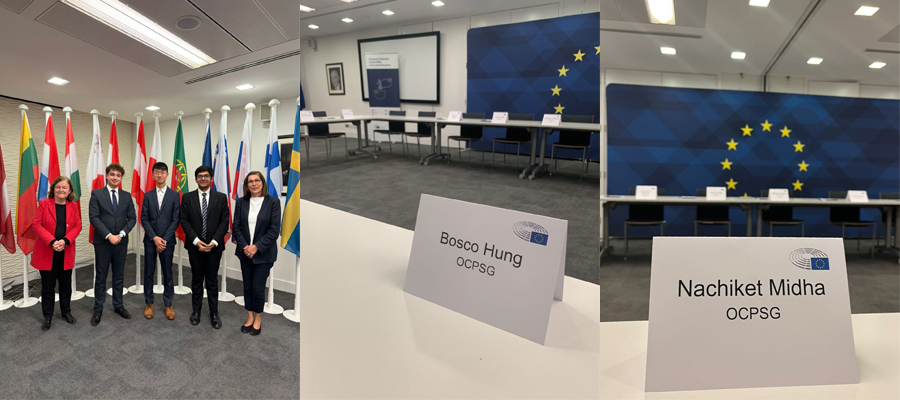
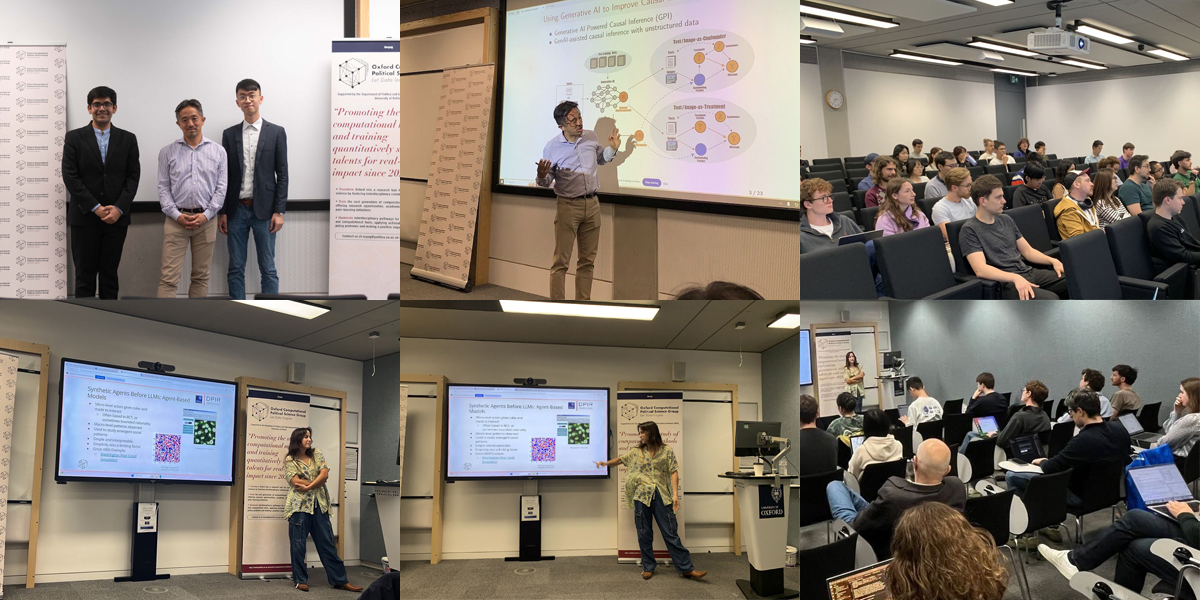
Oxford Computational Political Science Group
I co-founded the
Oxford Computational Political Science Group (OCPSG)
,
an Oxford-affiliated interdisciplinary research network supported by the Department of
Politics and International Relations (DPIR). OCPSG is a non-partisan initiative dedicated
to advancing computational methods in political science, fostering an environment that
blends political science with computational techniques to address complex political questions.
Policy engagement with EU Parliamentarians on Misinformation & DisinformationTalks and Workshops at OCPSG
Experience
Relevant AI Safety Experience
Research and Fellowship Manager
EA Oxford
I am currently working with the EA team at Oxford to help them launch the second iteration of their
Research Impact Oxford (RIO) fellowship. My main roles are research management and recruitment of mentors.
I will also help with the project scoping and research management during the 8-week fellowship, mostly working
with AI Safety and Biosecurity teams. Read more about RIO here
Jun 2026 – Jan 2027
AI Safety Research Fellow
Arcadia Impact, Impact First Fellowship
Led a small research team in the AI Safety stream, working on the governance of
persuasive AI. The resulting policy memo argues that the EU AI Act's compute-threshold
approach is a poor proxy for persuasion risk, and outlines an alternative framework for
defining and measuring it — presented to fellows and mentors at the end of the fellowship.
Feb 2026 – May 2026
AI Safety Core Fellow
Oxford AI Safety Initiative
Completed OAISI's Core Fellowship, a structured programme on the AI safety landscape,
through reading groups and discussion sessions on AI safety research agendas and threat
models. Used the feedback from peers and mentors to sharpen an early research agenda
and build broader fluency in AI governance and field strategy.
Jan 2026 – Apr 2026
Co-Founder & Director
Oxford Computational Political Science Group, University of Oxford
Built OCPSG from scratch into a research organisation running nine concurrent streams,
with partnerships spanning the EU Parliament and the British Academy. Beyond hiring and
running the organisation day-to-day, curated research streams on LLM benchmarking and
computational social science, and organised events and training workshops that fed into
the group's policy-facing engagements.
Dec 2024 – Present
Relevant Professional Experience
ESG & Impact Analyst
Prime Advocates, London)
Conduct ESG and impact analysis for corporate clients across UK and EU regulatory
contexts, covering sustainability, governance, and compliance metrics. Also research
how AI regulation intersects with ESG frameworks, including client obligations emerging
under the EU AI Act.
Aug 2025 – Jul 2026
Founder's Associate
MayaCode Global, UK/Germany
Worked directly with the founding team of a B2G civic tech startup on fundraising,
partnerships, government relations, and operations, including investor outreach and
partnerships with NGOs and government-facing stakeholders.
Mar 2025 – Jul 2025
Other Research Experience
Casual Researcher in Economics
National University of Singapore (Incoming Predoctoral Researcher from November 2026)
Apply regression, DiD, RDD, and other causal inference methods to administrative data
across Asia, and am building a RAG pipeline to systematically classify and analyse
institutional and governance variables from archival texts from British rule in Asia.
2026 – Present
Research & Lab Assistant
Centre for Experimental Social Sciences, University of Oxford
Support the design and running of behavioural and experimental studies in political
economy, including experimental protocols, participant sessions, and general research
operations for lab-based studies.
2026 – Present
Research Assistant
European Studies Centre, University of Oxford
Analysed parliamentary speeches and survey data across multiple countries to study
public attitudes and policy narratives, producing structured reports on EU external
relations from large-scale survey analysis.
May 2025 – Sep 2025
Publications & Writing
Peer-Reviewed
From Attock to Cuttack and from Kashmir to Kanyakumari: Understanding Akhand Bharat in Terms of Ontological Security.
King Edward VII Prize, Franco-British Entente Cordiale Challenge, Hatfield House — held under the patronage of King Charles III; awarded with an internship opportunity in sustainability and conservation with the Prince Albert II Foundation of Monaco2025
Swami Vivekananda Scholarship, Government of India — approx. £42,000 (85% tuition) towards Oxford MSc2024–25
Oxford-Cambridge India Scholar's Award, Oxford Cambridge Society of India — approx. £2,000 towards Oxford MSc2024
Harvard Kennedy School India Conference Finalist — Top 10 of 401 teams and 1,600+ participants; topic: tech-enabled micro-credit for farmers2024
FURHHDL Fellowship, Foundation for Universal Responsibility of His Holiness the Dalai Lama — fully-funded four-week immersion fellowship studying with the Tibetan community in Dharamshala, India2024
Emile Boutmy Scholarship, Sciences Po — €13,000/year towards a Master's at Sciences Po, Paris (Declined)2024–26
Departmental Valedictorian & Summa Cum Laude, PGDip in Advanced Studies & Research, Ashoka University2024
Magna Cum Laude, BA (Hons.) in Political Science & IR, Ashoka University2023
Dean's List (5 times), Ashoka University2020–23
Thoughts & Reflections
I write occasionally on As I See It,
my Substack. Mostly stuff on AI Safety, politics, and random thoughts. Latest posts below,
or subscribe directly on Substack.
If the embed above doesn't load, read directly on
Substack ↗.
 University of Oxford
 Nat'l Univ. of Singapore
 Ashoka University
 Centre for Policy Research
 ISAS, NUS
 Oxford AI Safety Initiative
 Arcadia Impact
 OCPSG, Oxford